ABOUT US
Adhering to the spirit of "dedication and focus", we provide craftsmanship products and serve millions of users

HOME
ABOUT US
PRODUCTS
Case
plan
NEWS CENTER
contact us
CHINESE
Production line components
13523220009
1、 Core functions and design objectives
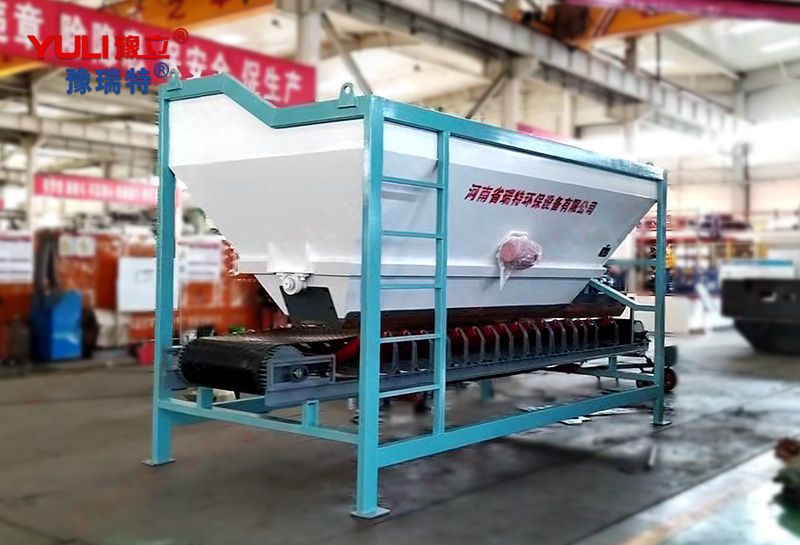
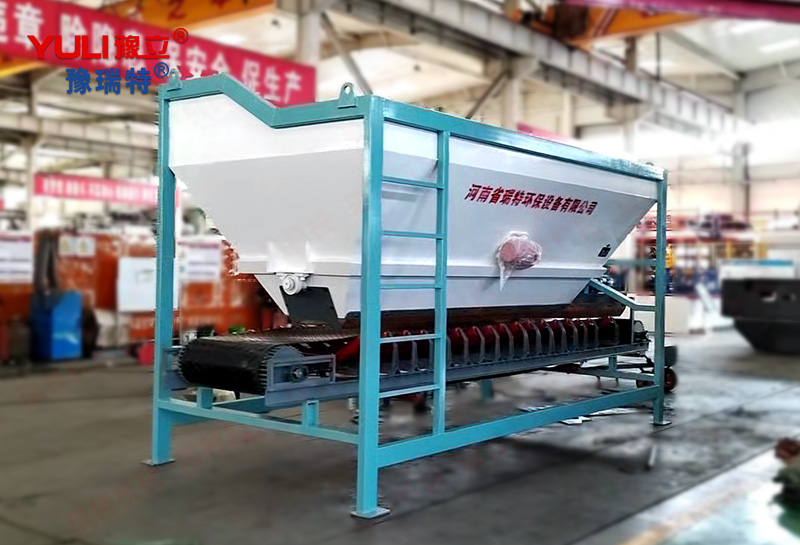
Its main function is to receive and temporarily store raw materials (such as livestock manure, straw, mushroom residue, etc.) transported by front-end forklifts, and to stably, controllably, and uniformly transport the materials to subsequent crushing, mixing, or fermentation equipment.
2、 Main features
1. Large capacity and adaptability
Large Capacity: The design capacity is usually 10 cubic meters to 50 cubic meters or even larger, which can receive multiple shovel materials at once, reduce the frequency of shovel back and forth, and improve efficiency.
Wide opening: The top of the warehouse is designed to be completely open or with a spacious feeding port, making it easy for the shovel to quickly and accurately dump materials from different angles without precise alignment.
High level design: The warehouse body is usually elevated, and its discharge outlet is located at the bottom, using the self weight of the material to fall and provide necessary height difference for subsequent equipment (such as belt conveyors and mixers).
2. Anti blocking and arch breaking design (the most critical feature)
Organic fertilizer raw materials have high moisture content and high viscosity, making them prone to "bridging" and "arching" in the warehouse, resulting in interrupted discharge. Therefore, the core technology of the feeding bin lies in forced arch breaking.
Warehouse wall structure:
Conical or parabolic bottom: This is the most basic design, using a sloping surface to guide material flow towards the central outlet and reduce dead corners.
Extra large tilt angle: The angle between the warehouse wall and the horizontal plane is usually designed to be much greater than the angle of repose of the material (usually greater than 60 °), ensuring that the material can slide smoothly.
Smooth inner wall: Stainless steel plate or polymer polyethylene lining plate is used on the inner wall to reduce the friction coefficient and prevent material adhesion.
Mechanical arch breaking device:
Hydraulic or electric arch breaker (also known as warehouse wall vibrator): installed on the side wall of the warehouse, it uses high-frequency vibration to shake off adhered materials.
Rotating arch breaking arm/mixing shaft: Install a rotating shaft with a scraper or blade above the discharge port to actively break up clumped materials.
Movable warehouse bottom: such as the "movable bottom" design, the entire bottom or part of the bottom plate can be horizontally moved or swung to force discharge.
3. Controllable and uniform discharge system
Core equipment - discharge machine: The bottom of the feeding bin is not directly open, but connected to professional discharge equipment to achieve controllable feeding. Common types include:
Double axis spiral discharge machine: Two spiral shafts rotate relative to each other, which can both transport and forcibly shear and mix materials, with good anti blocking effect, suitable for the most viscous materials.
Belt discharge machine: Design a wide edge guard belt at the bottom of the warehouse, and use the belt to move at a constant speed to remove the material. Suitable for materials with certain looseness and large conveying capacity.
Chain plate discharge machine: The principle is similar to a belt conveyor, but it has higher strength, wear resistance, and is suitable for materials containing impurities such as small amounts of stones and long fibers.
Stepless speed regulation: The drive motor of the discharge machine is usually equipped with a frequency converter, which can accurately adjust the discharge speed, thereby controlling the processing capacity of the entire production line and linking it with subsequent equipment.
4. Environmental protection and safety design
Dust removal interface: A dust removal air duct interface will be reserved on the top of the warehouse to connect to the factory's dust removal system. The dust generated during the forklift material dumping process will be promptly extracted to improve the workshop environment.
Safety grille/cover plate: When not feeding, open compartments should be covered or equipped with safety grilles to prevent personnel or foreign objects from falling.
Protective railing: Set around the work platform to ensure the safety of operators.
5. Durable and easy to maintain
Heavy duty structure: The main body is welded with thick walled carbon steel, which can withstand occasional collisions from forklifts and the impact of huge materials.
Wear resistant treatment: All parts that come into contact with materials and are prone to wear, such as spiral blades and lining plates, are subjected to wear-resistant welding or the use of wear-resistant steel.
Inspection door/observation port: set on the side wall for easy inspection of internal material conditions and equipment status, as well as for easy cleaning and maintenance in case of blockage.
3、 Selection and application suggestions
When choosing a forklift feeding bin, it is important to pay attention to the following points:
Material characteristics: Select the most suitable arch breaking scheme and discharge machine type based on the viscosity, moisture content, fiber content, and impurities of the material (dual axis spiral is the gold standard for handling high wet and viscous materials).
Capacity matching: The volume of the warehouse and the capacity of the discharge machine must match the hourly processing capacity of the production line, with a margin left.
Automation integration: The feeding bin should be linked and controlled with the back-end measuring equipment, mixing equipment, or fermentation turner to achieve automated and balanced production.
Mainly engaged in core products such as slatted board production lines and slatted board molds
Strong strength · Excellent equipment · Quality assurance · Customer first · Win-win cooperation
CONTACT:Manager Li 13523220009
TEL:0373-7774868
ADDRESS:South of the middle section of Weiqi Road, Xinxiang Economic and Technological Development Zone
 Follow us
LINK:
Xinxiang Ruite Machinery Co., Ltd ICP:豫ICP备10026059号-2
13523220009
扫一扫 关注我们