ABOUT US
Adhering to the spirit of "dedication and focus", we provide craftsmanship products and serve millions of users

HOME
ABOUT US
PRODUCTS
Case
plan
NEWS CENTER
contact us
CHINESE
Production line components
13523220009
After fermentation, organic fertilizer raw materials will form block shaped materials of varying sizes and high hardness (commonly known as "fermentation clinker"), which may also contain partially decomposed fiber clumps. The main function of the crusher is to:
Provide qualified raw materials for granulation: Grind the fermented clinker to a uniform fineness (usually 20-40 mesh), which is a prerequisite for obtaining high ball forming rate and uniform particles in subsequent disc, drum or extrusion granulators. Coarse particles can lead to difficulties in granulation and fragile finished products.
Ensure uniform appearance and quality of the product: Crush to make the final product delicate and uniform in texture, improve marketability, and ensure consistent distribution of maintenance points in each bag of product.
Guarantee for subsequent processes: For processes that require the addition of functional microbial agents, trace elements, or precise proportioning, a fine powder base is beneficial for uniform mixing.
Processing raw materials: Before fermentation, it is sometimes necessary to pre crush coarse auxiliary materials such as straw and rice husk to accelerate the maturation process.
2、 Main types and characteristics (classified by working principle)
The most commonly used crushers in organic fertilizer production are as follows, and the choice mainly depends on the characteristics of the material (humidity, fiber content, hardness) and production requirements.
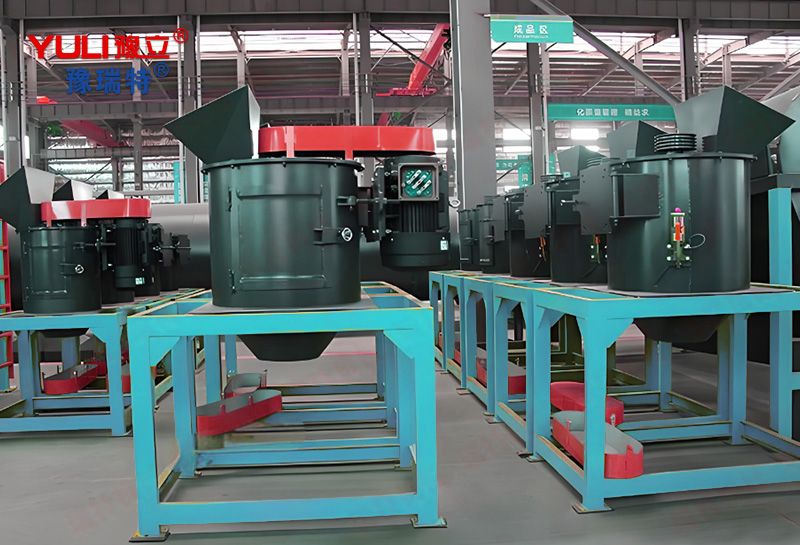
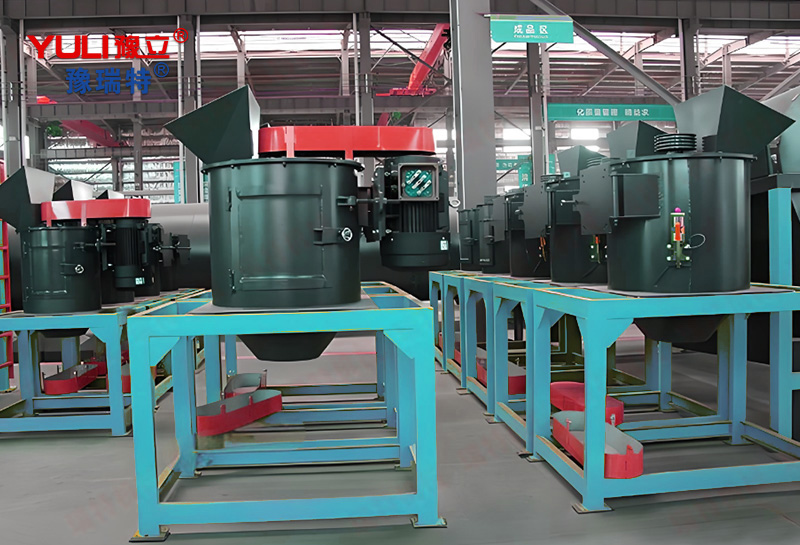
1. Chain crusher (vertical chain hammer crusher)
Structure: Multiple rows of freely swinging chains (or hammers) are installed on the main spindle that rotates at high speed in a vertical cavity.
Working principle: The material enters from the top and is violently hit and collided with the lining plate by a high-speed rotating chain. Through repeated impacts, it becomes finely divided, and the powder that meets the fineness requirements is discharged from the bottom sieve.
Advantages:
It has strong adaptability to high humidity materials and is the preferred and most commonly used equipment for processing fermented organic fertilizers with a moisture content of ≤ 30%.
Not easy to block, because the swinging chain has a certain self-cleaning effect.
High crushing ratio and high yield.
Disadvantages:
The work noise and dust are relatively high (dust removal equipment is required).
The chain and lining plate are vulnerable parts and need to be replaced regularly.
Applicable: Grinding of fermented clinker from standard organic fertilizers (livestock and poultry manure).
2. Semi wet material crusher (two-stage sieve free crusher)
Structure: It consists of two stages of rotors connected in series. The first stage is the pre crushing rotor (mostly a cutterhead or hammer), and the second stage is the fine crushing rotor (mostly a high-speed hammer). Usually there is no sieve.
Working principle: The material is first crushed into small pieces in the first stage, and then further crushed by the high-speed rotating hammer in the second stage. It is then circulated and impacted by the airflow inside the machine until the fineness meets the requirements before being sent out by the airflow.
Advantages:
The sieve free design completely solves the core problem of high fiber and high humidity materials blocking the sieve.
The crushing effect on fiber materials such as straw, weeds, and mushroom residue is very good.
The fineness can be controlled by adjusting the gap between the hammer head and the lining plate.
Disadvantages: The structure is relatively complex and the power consumption is high.
Application: Crushing of organic waste containing a large amount of fiber, such as straw fertilizer and garden waste compost.
3. Hammer crusher (horizontal)
Structure: Multiple sets of hammer plates are hinged on the horizontal rotor, and there is a circular mesh screen on the periphery.
Working principle: After the material enters, it is hit and sheared by a high-speed rotating hammer, and rubs against the sieve. Fine powder smaller than the sieve hole is discharged.
Advantages:
The structure is classic and widely used.
For dry and brittle materials, the crushing efficiency is high and the particle size is uniform.
Disadvantages:
Screen NetEase blockage, extremely unsuitable for organic fertilizer materials that are not completely dry or have high viscosity.
Replacing the screen and hammer is more complicated.
Applicable: Mainly used for crushing feed and dry grains. In the organic fertilizer production line, it is only applicable to the crushing of completely dried raw materials or finished products.
4. Cage crusher (double axis cage crusher)
Structure: Composed of two cage bars that rotate relative to each other, each cage is distributed in concentric circles with multiple steel bars.
Working principle: The material is crushed by impact, compression, and grinding between two cage bars rotating in opposite directions.
Advantages:
The crushing particle size is fine and uniform.
Relatively mild, with low heating.
Disadvantages:
The processing capacity is relatively small.
Not suitable for handling extremely hard or sticky materials, and the gap between the cage bars is prone to material jamming.
Applicable: Suitable for occasions that require fine fineness and low yield, such as fine crushing of high-quality organic fertilizers or functional bacterial fertilizers.
3、 Key selection and operation points
Core selection criteria:
Physical properties of materials: Moisture content is the primary indicator. >25% choose chain or semi wet materials; Semi wet materials are preferred for high fiber content; Fully dry (<15%) can be considered as hammer type.
Capacity requirement: Match the overall design output of the production line.
Finished product fineness requirement: determined according to the subsequent granulation process requirements (disc granulation usually requires 20-40 mesh).
System support: Reliable feeding devices (such as belt conveyors to prevent instantaneous overload) and dust removal systems (pulse bag dust collectors) must be equipped to improve the working environment and reduce material loss.
Key operations and maintenance:
It is strictly prohibited for metal foreign objects to enter: Before feeding, it must pass through a iron remover (permanent magnet drum or belt magnetic separator), which is the iron law to protect the crusher.
Uniform feeding: avoid excessive or insufficient feeding, prevent clogging or overloading of the motor.
Regular inspection and replacement of vulnerable parts: Hammer heads, chains, and lining plates will experience a sharp decrease in efficiency after wear, and require regular inspection and replacement.
Pay attention to bearing temperature and vibration: regularly add lubricating grease, and immediately stop the machine for inspection if there is abnormal vibration.
4、 Typical locations in organic fertilizer production lines
(Main location) After fermentation and before granulation:
Fermentation clinker → * * crusher * * → screening → mixing (adjusting moisture/nutrients) → granulation
This is its most core and standard position.
Return processing after granulation and before packaging:
Granulation → Screening → Qualified particles (unpackaged)+oversized particles/powder → * * Return to the crusher * * → Return to the mixing or granulation process
The processing capacity of the crusher here is relatively small, and the materials are usually drier.
Pre treatment of raw materials before fermentation (optional):
Coarse raw materials such as long straw → * * pre grinder * * → enter the mixing and stirring stage
Adopt models suitable for processing fibers.
Mainly engaged in core products such as slatted board production lines and slatted board molds
Strong strength · Excellent equipment · Quality assurance · Customer first · Win-win cooperation
CONTACT:Manager Li 13523220009
TEL:0373-7774868
ADDRESS:South of the middle section of Weiqi Road, Xinxiang Economic and Technological Development Zone
 Follow us
LINK:
Xinxiang Ruite Machinery Co., Ltd ICP:豫ICP备10026059号-2
13523220009
扫一扫 关注我们