ABOUT US
Adhering to the spirit of "dedication and focus", we provide craftsmanship products and serve millions of users

HOME
ABOUT US
PRODUCTS
Case
plan
NEWS CENTER
contact us
CHINESE
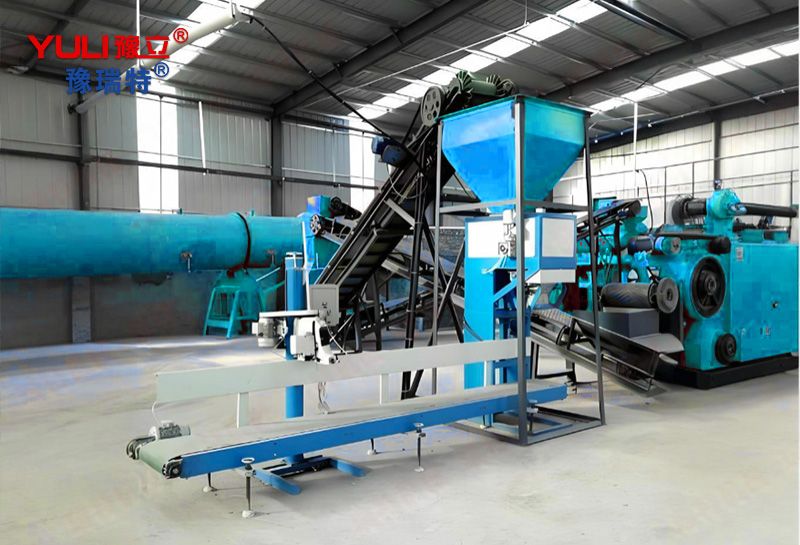
Production line components
13523220009
1、 Core role and importance
In organic fertilizer production, the purpose of mixing and stirring is far more than just "stirring evenly". Its core functions include:
Homogenization of raw materials: The main raw materials such as animal manure, straw, mushroom residue, and sludge are mixed with auxiliary materials (such as rice husks and sawdust to adjust moisture and carbon nitrogen ratio), functional microbial agents, and inorganic nutrients such as nitrogen, phosphorus, and potassium that may be added in a highly uniform manner. This is the basis for producing qualified organic fertilizers or bio organic fertilizers.
Adjusting key parameters: During the mixing process, by adding dry and wet materials, the moisture content, carbon nitrogen ratio, and pH value of the mixed materials are adjusted to the most suitable process range for subsequent fermentation (or direct granulation).
Creating conditions for fermentation: Uniform mixing allows for sufficient contact between microbial agents, oxygen, and nutrients, laying the foundation for efficient and uniform aerobic fermentation in the future.
Creating conditions for granulation: For direct granulation processes, uniformity of mixing and consistency of moisture are prerequisites for ensuring granulation forming rate and particle quality.
2、 Main types and characteristics
There are mainly three types of mixing mixers commonly used in organic fertilizer production lines, each with its own applicable scenarios:
1. Double shaft paddle mixer (most commonly used)
Structure: There are two parallel shafts with special angle blades installed inside the box, which achieve synchronous reverse rotation through a gearbox.
Working principle: The material is carried between two shafts, and under the action of high-speed rotating blades, it undergoes a composite cyclic motion along the axial and radial directions, quickly achieving mixing.
Advantages:
High mixing uniformity and fast speed (usually takes 30-120 seconds to complete a batch).
Good sealing performance can reduce moisture and odor leakage.
Can be designed for continuous or batch production.
Has a certain ability to disperse and break wet materials.
Disadvantages: The structure is relatively complex, the power consumption is high, and the maintenance cost is slightly higher.
Applicable: It is the most suitable raw material for organic fertilizers, especially for mixing animal manure with high moisture and strong viscosity with auxiliary materials. It is the first choice for modern organic fertilizer production lines.
2. Vertical mixer
Structure: There is a vertically installed spiral shaft in the center of the tank, which lifts the bottom material to the top and throws it down to achieve cyclic mixing.
Working principle: Mixing is achieved through the upward and scattering effects of a vertical spiral.
Advantages:
Small footprint.
Simple structure and low investment cost.
Mixing is relatively gentle.
Disadvantages:
Low mixing efficiency and long time.
The bottom is prone to blind spots, and the uniformity is not as good as the dual axis type.
Poor adaptability to viscous and agglomerated materials, prone to bridging or entanglement.
Applicable: Suitable for mixing powdered or small particle materials with low moisture content and good looseness, visible in small or simple organic fertilizer production lines.
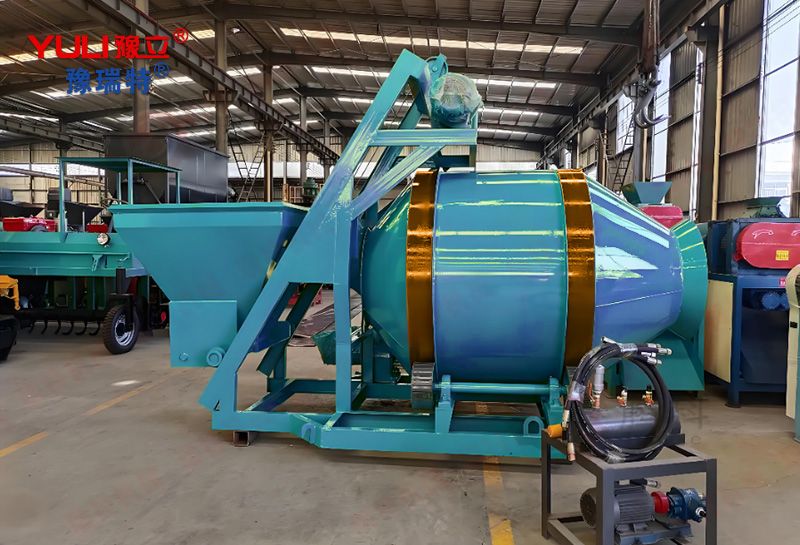
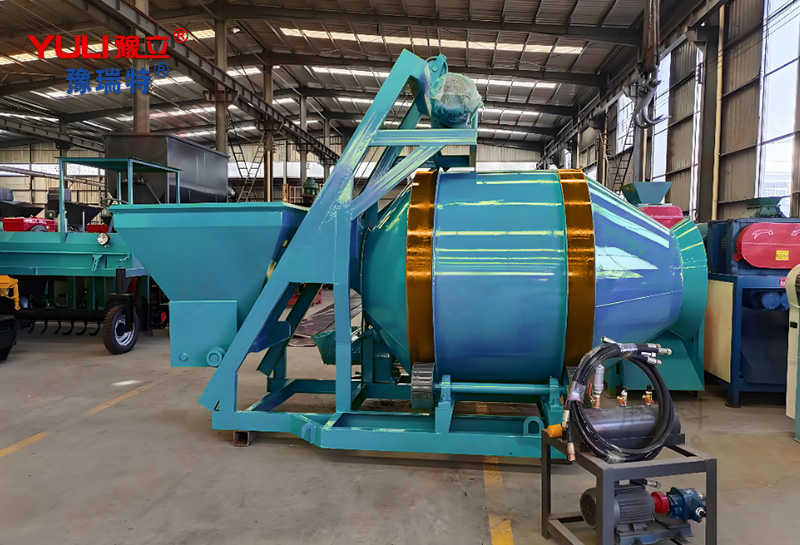
3. Drum mixer
Structure: A rotatable horizontal cylinder, usually equipped with a cutting or lifting plate inside.
Working principle: By relying on the rotation of the cylinder, the material is brought to a certain height and freely falls down to achieve diffusion mixing.
Advantages:
Simple structure and smooth operation.
Less material wear and tear.
It can be structurally connected with subsequent fermentation or drying processes.
Disadvantages:
Low mixing strength and average uniformity.
The mixing time is relatively long.
For viscous materials, they are prone to adhere to the cylinder wall and form "scabs".
Application: More commonly used for subsequent conditioning of materials (such as mixing with microbial agents after cooling) or drying processes, it has gradually been replaced by double shaft mixers as the main mixing equipment.
3、 Key selection and operation points
Selection criteria:
Material characteristics: moisture, viscosity, bulk density, and the presence of long fiber impurities (such as straw) are the primary considerations. The dual axis blade type has the strongest adaptability to high wet and viscous materials.
Capacity demand: Deciding whether to choose continuous (large processing capacity, suitable for large-scale production) or batch (fixed mixing time for each batch, facilitating precise control of the formula).
Process connection: matching with front-end feeding equipment (such as conveyors, batching scales) and back-end discharge equipment (such as fermentation feeding belts, granulators).
Material requirements: Stainless steel or carbon steel lined wear-resistant plates should be used for the parts in contact with damp and corrosive materials to extend their service life.
Key operating parameters:
Fill factor: The proportion of material volume to the effective volume of the mixer, usually 60% -80%. Excessively high will affect the mixing effect.
Mixing time: The shortest time to achieve the desired uniformity is determined through experimentation, and longer is not necessarily better.
Spindle speed: affects mixing strength and energy consumption.
Liquid addition system: If it is necessary to add bacterial liquid or water during mixing, there should be a spray device with good atomization.
Notes:
Start sequence: The mixer should be started first before feeding to prevent damage to the equipment caused by overloading.
Cleaning and maintenance: After the work is completed, it should be cleaned in a timely manner to prevent materials from getting stuck in the blades and box body.
Safety: It is strictly prohibited to insert hands or tools into the equipment during operation. During maintenance, the power must be turned off and a tag must be hung.
4、 Typical locations in organic fertilizer production lines
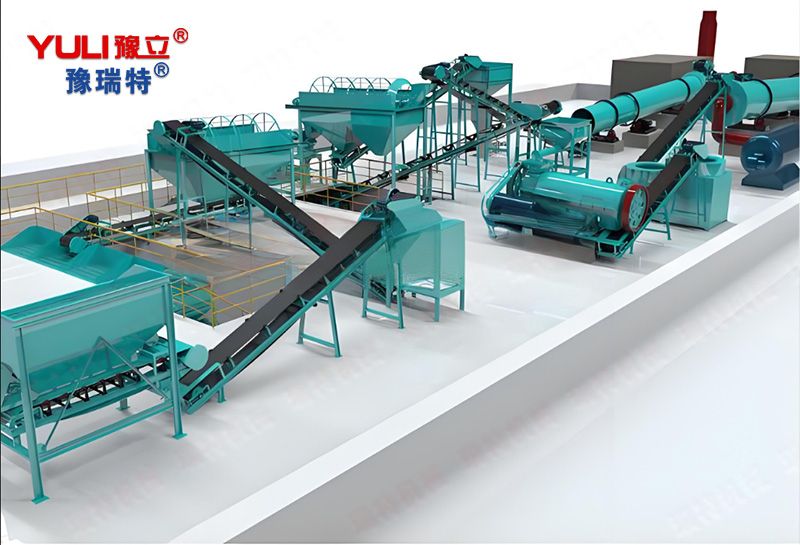
In a complete organic fertilizer production line, mixing mixers usually appear in two key sections:
Pre treatment section before fermentation:
Raw materials (feces, straw, etc.) → pretreatment (crushing, screening) → * * mixing mixer * * (adjusting moisture, C/N, adding microbial agents) → fermentation tank/flipping machine
This is its most important and core position.
Conditioning section before granulation (required by some processes):
Fermentation clinker → Crushing → Screening → * * Mixing mixer * * (adjust moisture, or add binders, inorganic nutrients) → Disc/drum granulator
The mixing here requires more precise moisture control, as the material is usually already loose.
Mainly engaged in core products such as slatted board production lines and slatted board molds
Strong strength · Excellent equipment · Quality assurance · Customer first · Win-win cooperation
CONTACT:Manager Li 13523220009
TEL:0373-7774868
ADDRESS:South of the middle section of Weiqi Road, Xinxiang Economic and Technological Development Zone
 Follow us
LINK:
Xinxiang Ruite Machinery Co., Ltd ICP:豫ICP备10026059号-2
13523220009
扫一扫 关注我们