ABOUT US
Adhering to the spirit of "dedication and focus", we provide craftsmanship products and serve millions of users

HOME
ABOUT US
PRODUCTS
Case
plan
NEWS CENTER
contact us
CHINESE
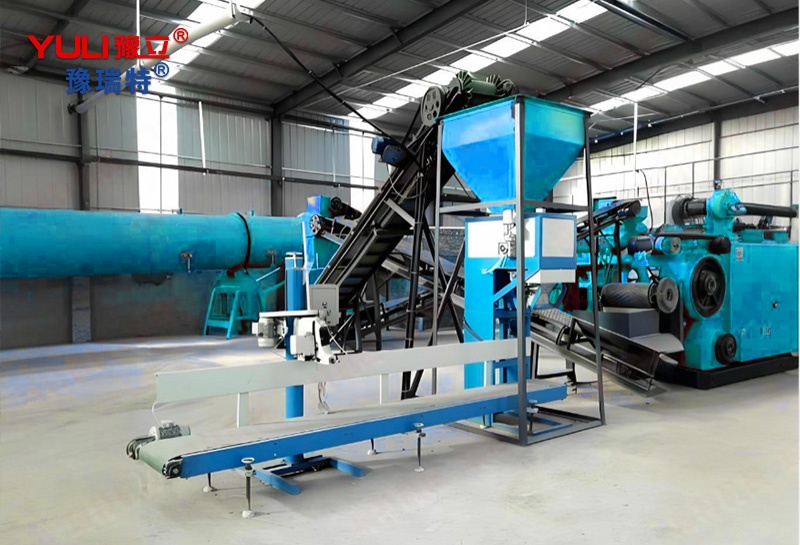
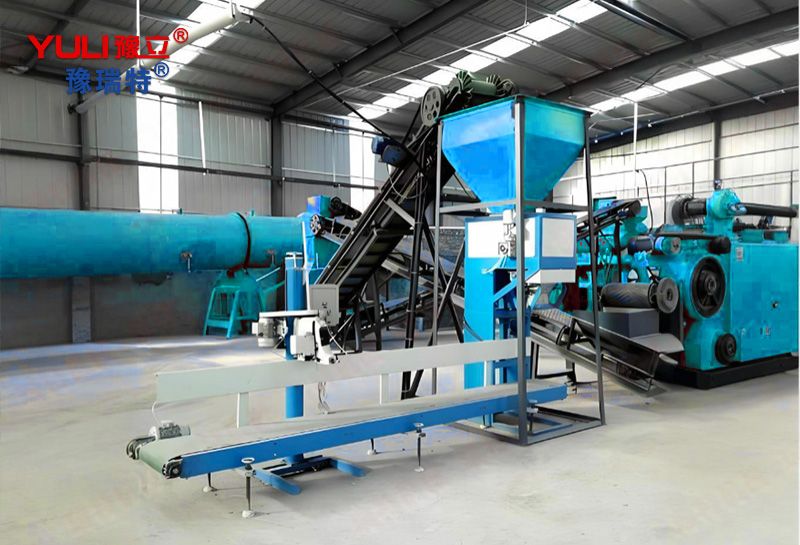
Production line components
13523220009
1、 Core role and importance
Quantitative accuracy: Quickly and accurately weigh bulk organic fertilizers according to preset weights (such as 40kg/bag, 25kg/bag), which is the foundation of trade fairness and a reflection of production standardization.
Improve efficiency: The fully automatic packaging speed can reach 600-1200 bags/hour, far exceeding manual packaging, significantly reducing labor costs and intensity.
Ensure hygiene and consistency: Closed conveying and packaging reduce dust spillage, improve the working environment, and the packaging appearance (such as stitching and bag type) is neat and uniform.
Realize product traceability: Modern packaging machines can easily be linked with inkjet printers and labeling machines to label each bag with production date, batch number, and other information.
2、 Main types and characteristics (classified by weighing method)
Organic fertilizer packaging mainly adopts quantitative automatic packaging scales. According to material characteristics and investment budget, there are mainly two mainstream types:
1. Net weight packaging machine
Working principle: The material is weighed in an independent weighing hopper, and after reaching the target weight, it is then placed in the prepared packaging bag at once.
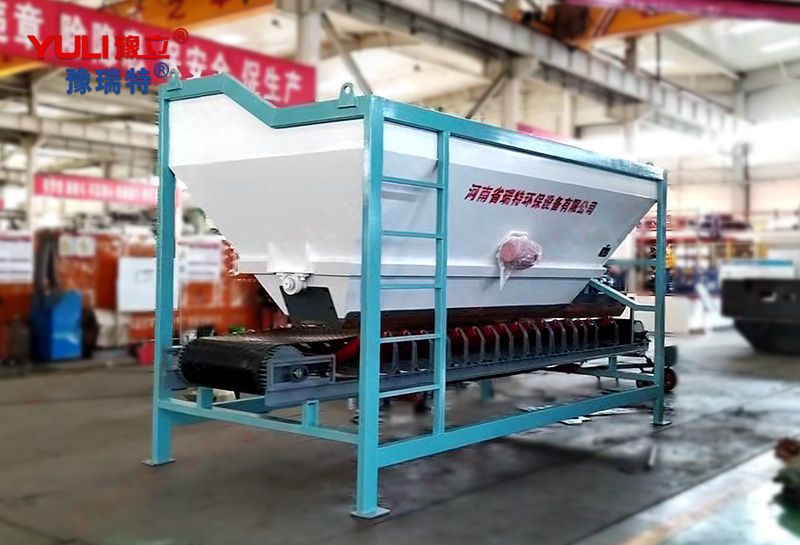
System composition: Storage bin → Feeding mechanism (fast/slow dual speed feeding) → Weighing hopper and high-precision sensor → Bag clamping device → Conveyor.
Advantages:
The measurement accuracy is extremely high. Due to the independence of the weighing process from material impact and material drop, the stability is good and the accuracy can usually reach ± 0.2%.
Fast speed and stable performance.
Changing packaging specifications is convenient.
Disadvantages:
The structure is relatively complex and the equipment investment is high.
The height is relatively high and requires a certain amount of installation space.
Applicable: The first choice for high-end organic fertilizer production lines, export products with strict precision requirements, and high-value bio organic fertilizers or specialized fertilizers.
2. Gross weight packaging machine
Working principle: The packaging bag is directly clamped and suspended by the bag clamp, and the material falls directly into the bag. The sensor directly weighs the total weight of the bag and the material.
System composition: storage bin → feeding mechanism → bag clamp and sensor integrated weighing → conveyor.
Advantages:
The structure is simple and compact, and the cost is relatively low.
The device has a low height and is easy to install and maintain.
Disadvantages:
The accuracy is affected by factors such as the weight difference of the packaging bag itself, material impact, and bag stability. The accuracy is usually around ± 0.5%, which is lower than the net weight formula.
The speed is relatively slow.
Applicable to small and medium-sized organic fertilizer factories with less stringent precision requirements and entry-level automated production lines with limited budgets.
3、 Key components and functions
A complete automatic packaging machine is not just a scale, but a system:
Feeding device:
Spiral feeder: The most commonly used, it achieves fast/slow feeding by controlling the screw speed, suitable for powder and small particle materials, with good sealing performance.
Gravity flow/vibration feeding: suitable for granular materials with very good fluidity.
Belt feeding: suitable for easily damaged lightweight particles.
Weighing unit: the core part, including sensors, weighing control instruments (which can set weight, bag number, statistical output, etc.).
Bag clamping and unloading mechanism: automatically clamps the bag opening, loosens the bag automatically after weighing, and the material falls into the lower conveyor.
Supporting equipment (determining degree of automation):
Automatic bagging machine (optional): The robotic arm automatically picks up, opens, and covers bags, achieving full automation and being expensive.
Folding sewing machine/heat sealing machine: Automatically sew (with thread) or heat seal (with laminated woven bags) the filled bag opening.
Conveyor: including bag dumping machine, shaping machine, metal detection machine, weight re inspection machine, coding machine, robot palletizing system, etc., forming a complete packaging assembly line.
4、 Special considerations for organic fertilizer materials
Organic fertilizer materials have their own characteristics, and when choosing a packaging machine, the following must be considered:
Dust control: Organic fertilizers are mostly in powder or fine particles, with high dust levels. The packaging machine should be designed with a good dust-proof structure (such as soft connections, dust removal interfaces) and equipped with a dust removal system.
Corrosivity: The fermented organic fertilizer is weakly acidic and corrosive. The parts in contact with materials (such as silos, spirals, and scales) should be made of stainless steel or treated with anti-corrosion measures.
Liquidity: Changes in humidity and particle size of organic fertilizers can affect their fluidity. The feeding mechanism needs to be able to adapt and prevent bridging and arching. The silo is often equipped with a vibrator or arch breaking device.
Impurities: The material may contain small fibers or clumps. The equipment needs to have a certain anti-interference ability, and the feed inlet is designed with a filter screen.
5、 Key selection points and production line integration
Determine core parameters:
Packaging specifications: commonly used bags weigh 20kg, 25kg, 40kg, and 50kg per bag.
Packaging speed: determined based on the production line capacity (such as the number of bags per hour corresponding to an annual production of 50000 tons and 100000 tons).
Measurement accuracy requirements: Meet national standards (such as GB 18382-2021 "Content and Requirements for Fertilizer Identification" for net content) and customer requirements.
Packaging bag type: valve pocket (no need for seams, more environmentally friendly but expensive) or open pocket (requiring seams or heat sealing).
Selection of automation level:
Semi automatic: manual bagging → automatic weighing and filling → manual bag retrieval → manual sewing machine. Small investment is the most common.
Fully automatic: automatic bagging → automatic weighing and filling → automatic sewing/folding → automatic conveying and palletizing. Extremely high efficiency, minimal labor, and large investment.
Integration location of production line:
Finished product silo → * * packaging machine * * → conveying → sewing/sealing → metal detection/weight re inspection → coding → palletizing → warehousing
Mainly engaged in core products such as slatted board production lines and slatted board molds
Strong strength · Excellent equipment · Quality assurance · Customer first · Win-win cooperation
CONTACT:Manager Li 13523220009
TEL:0373-7774868
ADDRESS:South of the middle section of Weiqi Road, Xinxiang Economic and Technological Development Zone
 Follow us
LINK:
Xinxiang Ruite Machinery Co., Ltd ICP:豫ICP备10026059号-2
13523220009
扫一扫 关注我们