ABOUT US
Adhering to the spirit of "dedication and focus", we provide craftsmanship products and serve millions of users

HOME
ABOUT US
PRODUCTS
Case
plan
NEWS CENTER
contact us
CHINESE
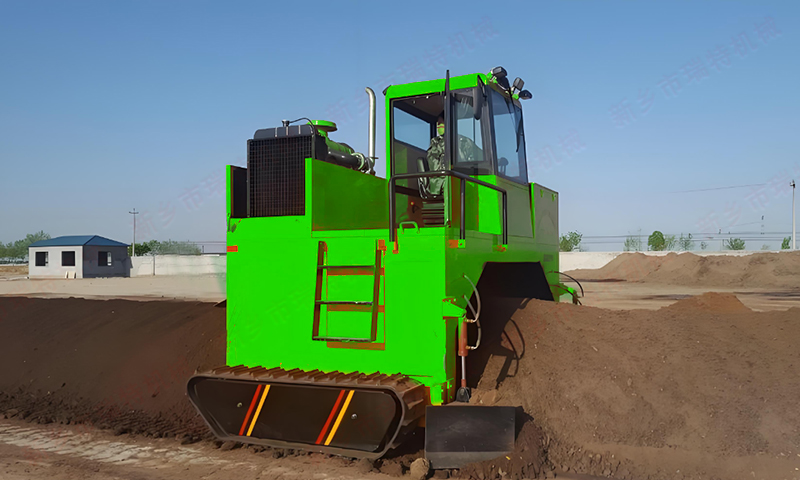
Introduction: The production efficiency that is "stuck" is a common pain point in an industry
The problem of material adhesion has always been a persistent issue for producers in the process of organic fertilizer turning and dumping using a tracked stacker. Especially for high humidity and high viscosity materials such as livestock manure, kitchen waste, and sludge, traditional turning machines commonly suffer from three major problems during operation: severe adhesion, sharp reduction in effective turning amount, and soaring energy consumption. Actual test data shows that under the condition of viscous materials, some models have an effective flipping loss of up to 40%, which is equivalent to 4 hours of useless work every 10 hours of operation.
As a professional manufacturer specializing in the research and development of organic fertilizer track type turning machine technology, we have successfully developed a full chain anti adhesion technology system after five years of continuous research and development, controlling the adhesion rate below 5% and completely changing the dilemma of high viscosity material turning operation.
1、 The technical essence behind the adhesion phenomenon: why do materials stick and not release?
To solve the problem, it is necessary to first understand the triple physical mechanism of material adhesion:
Surface adsorption effect: A molecular level adsorption layer is formed between the material and the metal surface
Capillary action: the siphon adhesion force generated by water in micro pores
Mechanical interlocking: Physical entanglement between fiber materials and equipment surfaces
The traditional solution for track type stackers often stays in a single dimension, such as simply adding non stick coatings, while ignoring the fact that adhesion is the result of the coupling effect of multiple factors. True technological breakthroughs require systematic solutions.
2、 Four dimensional anti sticking technology system: from passive cleaning to active prevention
Dimension 1: Innovation of Material Surface - Molecular level Non stick Interface
Core Technology: Gradient Composite Coating System
We have abandoned the traditional single PTFE coating scheme and developed a four layer composite structure:
Grassroots: High hardness alloy steel, providing structural support
Transition layer: Micro porous ceramic coating to enhance adhesion
Functional layer: Modified nano ceramic polymer composite material, with a hardness of HV800
Surface layer: Low surface energy fluorosilicone polymer, with a surface energy as low as 18mN/m (72mN/m for water)
Actual test effect:
Adhesive force reduced by 76%
Wear resistance life increased by 3 times
Significant enhancement of self-cleaning performance
Dimension 2: Innovation in Structural Design - Biomimetic Non stick Surface
Core technology: Imitation of lotus leaf micro nano structure surface
Drawing on the "self-cleaning" principle of lotus leaves in nature, we have designed:
Macro surface: Large curvature transition to avoid dead corners caused by material accumulation
Microstructure: Regular convex array of 50-200 μ m, reducing contact area
Nanotexture: Surface hydrophobic treatment, contact angle>150 °
Working mechanism:
The actual contact area between materials and equipment surfaces has been reduced to 12%, fundamentally weakening the adhesive foundation.
Dimension 3: Mechanical assisted peeling - dynamic anti sticking technology
Core technology: High frequency micro vibration+airflow assisted dual system
High frequency micro vibration system:
Integrated piezoelectric ceramic vibrator at the root of the cutting tool
Operating frequency: 800-1200Hz (adjustable)
Amplitude: 0.1-0.5mm
Function: To break the adhesive bond between the material and the surface
Airflow assistance system:
Arrange micro air holes along the cutting edge of the tool
Continuous injection of low-pressure airflow at 0.3-0.5MPa
Form an 'air cushion isolation layer'
Especially effective in preventing the formation of initial adhesion
Synergistic effect: Vibration destroys existing adhesion, airflow prevents new adhesion, and forms a dynamic anti adhesion loop.
Dimension Four: Intelligent Parameter Adaptation - Breakthrough from Fixed to Adaptive
Core technology: Material state recognition and parameter adaptive system
The traditional tracked stacker adopts fixed parameters for different materials, while our intelligent system achieves:
Real time monitoring: Real time determination of material viscosity through torque sensors and visual recognition
Dynamic adjustment: automatically matching the optimal tool speed, vibration frequency, and travel speed
Memory learning: Establishing a material characteristic database, the more it is used, the more "intelligent" it becomes
Intelligent anti sticking control logic:
text
Material humidity>65% → Activate high-frequency vibration mode
High fiber content in the material → increase the auxiliary pressure of the airflow
Low ambient temperature → Moderately increase tool speed to prevent material freezing
3、 Full process anti sticking operation plan: from single point optimization to system solution
Stage 1: Pre processing optimization before homework
Suggest controlling the moisture content within the optimal range of 55-65%
Add appropriate auxiliary materials to adjust material characteristics
Equipment preheating to prevent adhesion during cold start
Stage 2: Intelligent Control in Homework
Progressive entry "technology to avoid sudden high loads
Load balancing algorithm for crawler stacker cutter to prevent local overload
Real time adhesion rate monitoring and warning
Stage 3: Efficient cleaning after homework
Dedicated self-cleaning program, quickly cleans residues in 30 seconds
Optional high-pressure water automatic cleaning system
Quick disassembly design for key parts, convenient for deep maintenance
4、 Comparison between measured data and economic benefits
Our comparative test conducted at a large poultry manure treatment plant showed that:
| indicator | traditional equipment | Our anti-adhesion technology equipment | increase margin |
|---|---|---|---|
| effective turning volume | 60-70% | 95-98% | +40% |
| energy consumption per unit | 100% | 68% | -32% |
| cleanup time | 2hour | 15minutes | -87.5% |
| tool life | 3months | 8months | +166% |
Economic value conversion:
Taking an organic fertilizer plant that processes 200 tons per day as an example, the annual direct economic benefits increase by about 280000 yuan (calculated based on a profit of 150 yuan per ton of organic fertilizer), and the equipment investment payback period is shortened to 1.2 years.
5、 Continuous iteration of technology: a leap from solution to prevention
Anti sticking technology is not the end point of track type stackers, but the starting point. The next generation technologies we are developing include:
Superhydrophobic Intelligent Surface: Active Adjustable Surface with Contact Angle>170 °
Ultrasonic anti sticking system: contactless anti sticking technology
Material modification pretreatment unit: pretreatment system linked with the flipping machine
CONTACT:Manager Li 13523220009
TEL:0373-7774868
ADDRESS:South of the middle section of Weiqi Road, Xinxiang Economic and Technological Development Zone
 Follow us
LINK:
Xinxiang Ruite Machinery Co., Ltd ICP:豫ICP备10026059号-2
13523220009
扫一扫 关注我们