ABOUT US
Adhering to the spirit of "dedication and focus", we provide craftsmanship products and serve millions of users

HOME
ABOUT US
PRODUCTS
Case
plan
NEWS CENTER
contact us
CHINESE
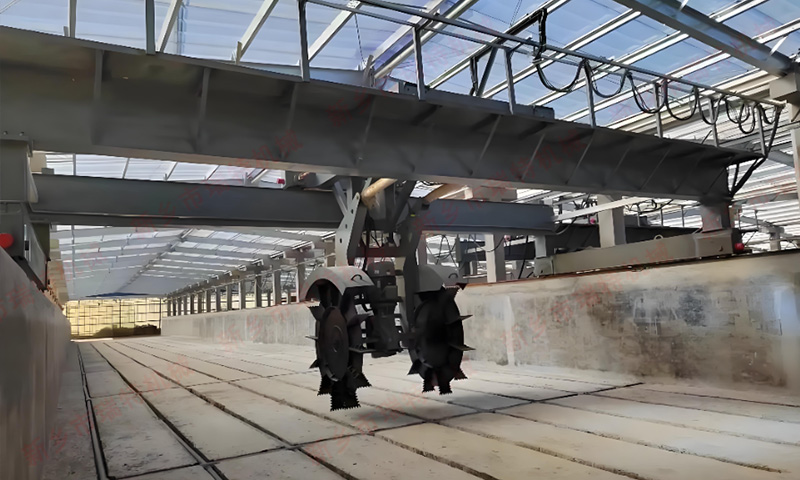
Why is the trough type flipping machine designed for "forward" flipping?
The design and rotation direction of the blade roller of the trough flipping machine are precisely calculated, and its "forward" working mode aims to achieve the following core functions:
Crushing and mixing: The cutting tool cuts into the material at a specific angle, and during the process of throwing the material backwards (relative to the direction of machine advancement), it can effectively break up clumps, make the material loose, and fully mix the outer layer with the central layer, new material with old material.
Uniform scattering and fluffy stacking: After the material is thrown backwards, it will form a uniform and fluffy stacking profile. This creates the optimal porosity, which is crucial for oxygen transport, water evaporation, and heat dissipation in aerobic fermentation.
Controllable displacement: With each forward flip, the material undergoes a cohesive and controllable displacement (usually a few meters) along the length of the fermentation tank, which helps the material move gradually throughout the fermentation cycle.
What would happen if the 'reverse' flip occurs?
Assuming that the trough type flipping machine is reversed while the blade roller is reversed (or even if not reversed), attempting to achieve "reverse flipping" will result in:
Material stacking and compaction: The material will not be effectively thrown backwards, but may instead accumulate and be compressed in front of the knife roller, resulting in the material being compacted. This is completely opposite to the "fluffy" state required for fermentation.
Uneven flipping: Unable to form an effective throwing arc, the material in the central area may not be processed, while the material at the edges may be pushed to the edge of the trough, resulting in extremely uneven fermentation.
Impact on fermentation process: The porosity of compacted materials drops sharply, oxygen cannot enter, heat is difficult to dissipate, and moisture cannot be discharged. This can cause a slowdown in fermentation rate, abnormal temperature (local overheating or overall low temperature), and even create an anaerobic environment, emitting a foul odor.
Increasing equipment load: The knife roller and hydraulic system may operate under non design conditions, encountering greater resistance, resulting in increased energy consumption, accelerated tool wear, and even damage to transmission components or machine shutdown.
Displacement out of control: The direction and distance of material movement become uncontrollable, disrupting the material advancement plan of the entire fermentation tank.
So, under what circumstances would a "reverse" operation be considered?
Usually, the term 'reverse' mentioned in the operation only refers to the overall walking direction of the machine, not the flipping action itself. For example:
At the end of the flipping operation, return the machine to its starting position with no load.
When encountering abnormally hard or tangled objects during the flipping process, it is possible to briefly reverse to avoid damaging the equipment, but this is not "reverse flipping of materials".
What is the correct solution?
If you feel that materials need special handling in a certain area (such as corners or uneven stacking), the correct method is:
Plan the path and number of forward flips.
At points that require special handling, stop the trough type flipping machine and perform multiple local, forward flipping operations instead of attempting to reverse.
For design blind spots, other auxiliary tools (such as forklifts) should be used for pre sorting, and then the flipping machine should be used for regular operation.
CONTACT:Manager Li 13523220009
TEL:0373-7774868
ADDRESS:South of the middle section of Weiqi Road, Xinxiang Economic and Technological Development Zone
 Follow us
LINK:
Xinxiang Ruite Machinery Co., Ltd ICP:豫ICP备10026059号-2
13523220009
扫一扫 关注我们