Introduction to Chicken Manure Organic Fertilizer Equipment Products
2026-01-28
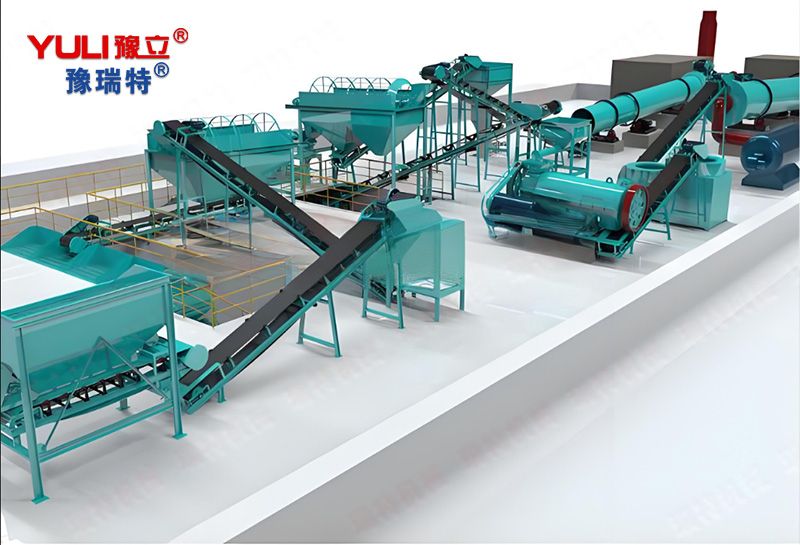
The chicken manure organic fertilizer equipment is a complete set of
production equipment that uses fresh chicken manure as raw material and
undergoes a series of processing to produce natural organic chicken manure
fertilizer. The production line of chicken manure organic fertilizer requires
two steps for processing commodity organic fertilizer: the early fermentation
and treatment part and the deep processing granulation part. The supporting
equipment for bio organic fertilizer includes fermentation turntables, organic
fertilizer crushers, drum screening machines, horizontal mixers, disc
granulators, rotary dryers, coolers, screening machines, coating machines,
packaging machines, conveyors, and other equipment. Characteristics of Chicken Manure Organic Fertilizer: 1. Chicken manure organic fertilizer does not contain any chemical
components. Due to the poor digestion ability of chickens, only 25% of the
nutrients can be consumed, while the other 75% of the nutrients in the feed are
excreted with the manure, resulting in dry products containing nitrogen,
phosphorus, potassium, organic matter, amino acids, proteins, and other
components. 2. The main substance in chicken manure organic fertilizer is organic
matter, which increases the organic matter content in the soil. Organic matter
can improve soil physical, chemical, and biological properties, mature soil, and
enhance soil fertility. The proverb in rural areas of our country that "land
relies on manure for nourishment, and seedlings rely on manure for growth"
reflects to some extent the role of chicken manure organic fertilizer in
improving soil. 3. Chicken manure organic fertilizer not only adds a lot of organic
colloids, but also decomposes and converts many organic substances into organic
colloids through the action of microorganisms. This greatly increases the soil
adsorption surface and produces many adhesive substances, which bind soil
particles together into a stable aggregate structure, improving soil water
retention, fertilizer retention, and air permeability, as well as regulating
soil temperature. 4. Chicken manure organic fertilizer can also promote the proliferation of
microorganisms in the soil, especially many beneficial microorganisms such as
nitrogen fixing bacteria, ammonifying bacteria, cellulose decomposing bacteria,
nitrifying bacteria, etc. Chicken manure organic fertilizer contains various
active enzymes secreted by animal digestive tracts and enzymes produced by
microorganisms. These substances, when applied to the soil, can greatly enhance
the enzyme activity of the soil. 5. Applying more chicken manure organic fertilizer can improve soil
activity and biological reproduction and transformation ability, thereby
enhancing soil absorption, buffering, and stress resistance. Process flow: The process of producing organic fertilizers mainly includes crushing,
batching, mixing, granulation, drying, cooling, screening, and packaging. The
production capacity of a single production line equipment should be between
1-10t/h. If it is too small, it will not achieve economic scale, and if it is
too large, it will increase the difficulty of transporting and storing raw
materials and finished products. Step 1: Fermentation: Collect chicken manure and urine, mix them with hay
and rotten silage to make compost, and let it ferment. When fermenting and
planting, use a turner to fully ferment chicken manure. Only timely and even
turners can achieve this. Do not make some places very dry and some places very
wet, as this will affect the fermentation quality. It is recommended to use a
turning machine. Fermentation method: (1) Add auxiliary materials Add 10% -15% straw, rice bran and other auxiliary materials to fresh
chicken manure to regulate moisture, ventilation and carbon nitrogen ratio. The
carbon nitrogen ratio should be between 30-40, and the moisture content of
chicken manure should be controlled at around 60%, with watermarks between
fingers but not dripping. (2) Inoculate fermentation agent Add 0.04% probiotic starter culture (mix the starter culture with 10 times
wheat bran and then add it to chicken manure), mix well, and transfer to the
fermentation tank to stack in a ladder shape with an upper width of 2m, a lower
width of 3m, and a height of 1.2m. The length depends on the length of the site,
compact and seal, and cover with plastic or waterproof cloth for anaerobic
fermentation. The fermentation time is 15-40 days (depending on the season). (3) Material flipping (mechanical or manual flipping) During winter and spring, the material is flipped every 10 days at noon,
and during summer and autumn, it is flipped every 5 days to maintain the
fermentation temperature between 55-70 ℃. The fermentation temperature can be
measured and controlled by a stick type digital thermometer. After flipping the
pile three times, fermentation can be successful. The characteristics of this process are: strong maneuverability of
mechanical turning and stacking operations, and the use of strip stacking
materials is conducive to the loss of moisture in the later stage of composting;
Low requirements for civil engineering, no need for supporting fermentation
tanks, can be stacked outdoors, saving construction investment; The composting
site area needs to be relatively larger; Outdoor composting in northern regions
has poor insulation in winter, and the composting cycle needs to be extended or
stopped seasonally; During the rainy season, open-air composting can easily
affect the pile. It is recommended to cover it with a rain shelter if conditions
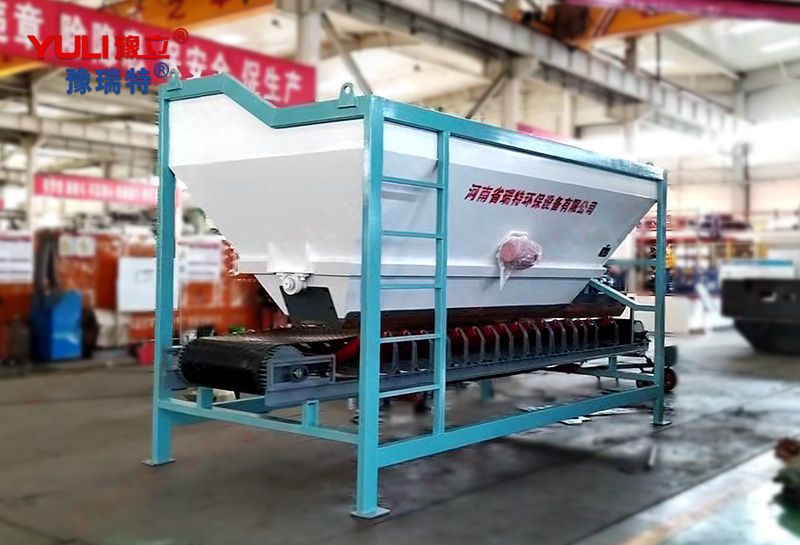
permit. Step 2: Grind and mix ingredients Use the ingredient warehouse to crush, mix, and blend the composted
materials with inorganic fertilizers such as N, P, K, and other additives in a
certain proportion through a material crusher and a horizontal mixer. The
function of this system is to crush, ratio, and mix various raw materials such
as composted materials, nitrogen, phosphorus, potassium inorganic fertilizers,
and other additives in a certain proportion. Based on years of experience, the
recommended equipment configuration is as follows: using a vertical crusher to
crush chicken manure compost is not easy to stick to the wall and block, and a
multi-layer turbulent chain hammer structure improves crushing performance;
Adopting a continuous automatic batching system suitable for dynamic metering
and batching control of organic fertilizer raw materials; The mixed operation is
equipped with a dual axis continuous mixer, which has good sealing performance
and makes it difficult for wet materials to adhere to the root of the mixing
shaft. Step 3: Granulation Use an organic fertilizer granulator to granulate materials. The function
of this system is to make particles from the material that has been thoroughly
mixed with crushed ingredients. Flat die granulator is suitable for granulation,
which has the advantages of wide adaptability to raw materials, especially
suitable for organic materials, with broad requirements for raw material density
and moisture content, and does not require drying of raw materials; The diameter
of the pressure roller is large, and the template can be used on both sides. The
material is evenly distributed in the compression chamber, ensuring stable
granulation and high particle forming rate. The finished particles have a
uniform appearance and are not easily broken; The entire granulation process
does not add water, saving the cost of subsequent particle drying; The fineness
requirement for raw material crushing is not high. Granulated raw materials
(after composting) generally do not require fine crushing, and small stones can
be directly crushed without easily blocking the pressure plate mold holes Step 4: Screening and Return System The granular materials output from the granulation molding system have
certain differences in particle size and need to be screened and classified. The
selected rotary screening machine requires low vibration, low noise, easy screen
replacement, and is equipped with a screen surface cleaning device. It is
recommended to equip an automatic material return system to screen the
unqualified large and small particle materials, which are then transported out
by a belt elevator and re crushed before being sent to the granulator for
further granulation. This will help improve the continuous operation capacity of
the production line. Step 5: Drying Use an organic fertilizer dryer to further remove moisture from the
screened particles to meet the standard requirements for organic fertilizer
moisture content, while improving particle shaping during drying. Step 6: Cooling Using a cooling machine to cool granular materials helps to store and
preserve the quality of the particles. The hot granular materials output by the
drying machine enter the counter current cooler from above, and the dry air
enters from the lower part of the cooler under the action of the cooling fan,
and undergoes sufficient cold and hot exchange with the moist and hot particles
from the upper part to the lower part. After cooling, the difference between the
particle temperature and the ambient temperature is less than 5 ℃. Step 7: Packaging The cooled granular material is transported into the finished product
warehouse through a bucket elevator. Granular materials are quantitatively
weighed and packaged using an automatic packaging scale. The automatic packaging
machine is controlled by a microcomputer and can achieve multi range
measurement. It has high weighing accuracy, automatic clamping, sewing,
automatic peeling and weight detection functions, and its advantages are
incomparable to manual packaging. control system The entire production line is equipped with numerous devices. To ensure the
normal and orderly continuous production, it is recommended to adopt a control
system that combines centralized display, centralized control, and on-site
control in the control room. Control cabinets, control consoles with analog
screens, and computer systems should be set up in the control room. The
equipment can be started and stopped through a simulation screen, and on-site
control cabinets are equipped for equipment such as granulators that are far
apart for easy on-site operation. By using a computer to control the ingredient
mixing system in real-time according to the formula, the operating status of the
equipment can be dynamically monitored. It has the functions of setting,
modifying, and storing formulas and batches, as well as generating and printing
reports for various materials and total output on a shift, daily, and monthly
basis, which facilitates production management.


 Follow us